Difference Between Disposable And Discretionary Income
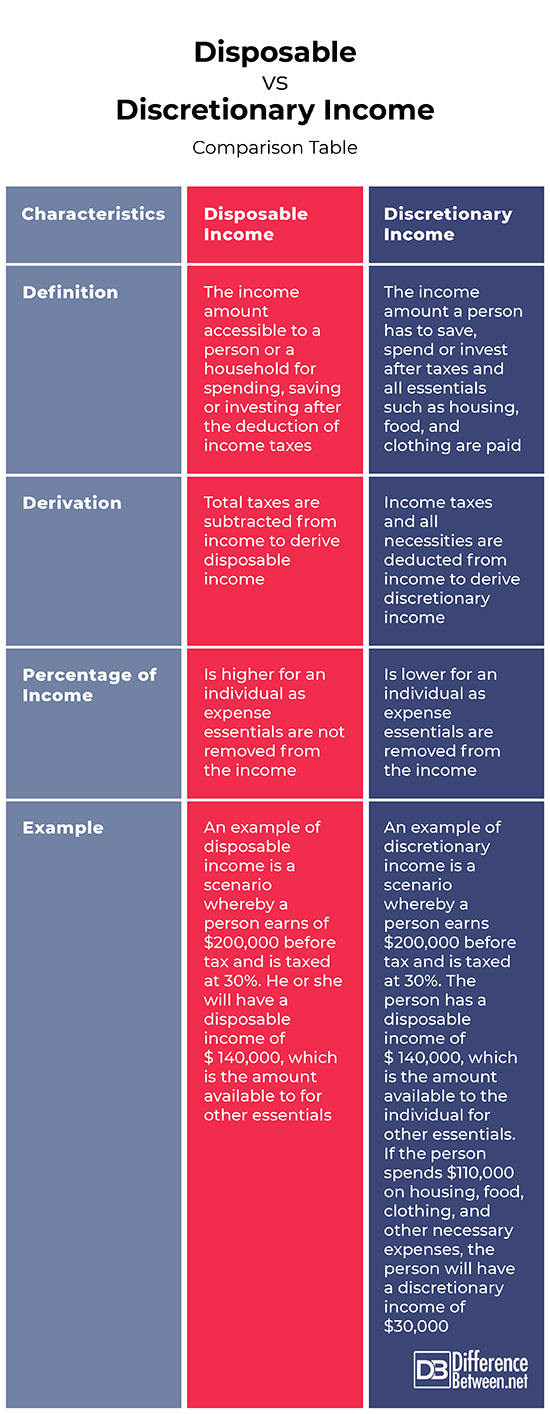
Difference Between Disposable And Discretionary Income. The difference between disposable & discretionary income. An example of discretionary income is a scenario whereby a person earns $200,000 before tax.
The term "income" refers to a financial value that creates savings and spending opportunities for an individual. However, income can be difficult to define conceptually. So, the definition of income can vary based on the research field. With this piece, we'll review the main elements of income. We will also examine rents and interest.
Gross income
It is defined as the amount of your earnings after taxes. However, net income is the total amount of your earnings less taxes. It is essential to recognize the distinction between gross income as well as net income so you can correctly report your income. Gross income is a better gauge of your earnings as it gives you a clearer view of the amount of money you earn.
Gross income is the amount that a business makes before expenses. It lets business owners compare results across various times of the year and determine seasonality. It also assists managers in keeping on top of sales targets and productivity requirements. Knowing how much a company earns before expenses is essential to managing and growing a profitable business. It aids small-business owners know how they're faring in comparison to their rivals.
Gross income can be calculated as a per-product or company-wide basis. A company, for instance, can calculate its profit by product with the help of tracking charts. If a product sells well an organization will enjoy an increase in gross revenue in comparison to companies that have no products or services at all. This will allow business owners to determine which products they should concentrate on.
Gross income comprises interest, dividends rental income, gambling winners, inheritances, as well as other sources of income. But, it doesn't include payroll deductions. When you calculate your income, make sure that you subtract any taxes that you are legally required to pay. Also, gross income should never exceed your adjusted gross earnings, or the amount you actually take home after accounting for all deductions you've taken.
If you're employed, you probably know what your gross income is. In many cases, your gross income is the amount you earn before taxes are deducted. The information is available on your pay statement or contract. When you aren't able to find the documentation, you can get copies.
Gross income and net income are important parts of your financial life. Knowing and understanding them will help you develop a forecast and budget.
Comprehensive income
Comprehensive income represents the total change in equity during a specified period of time. It excludes changes in equity that result from ownership investments and distributions made to owners. It is the most frequently employed measure to assess the effectiveness of businesses. It is an extremely significant element of a business's profitability. It is therefore important for business owners recognize the implications of.
Comprehensive income was defined in FASB Concepts Statement number. 6, and includes any changes in equity coming from sources different from the owners the business. FASB generally follows this comprehensive income concept but sometimes it has made exceptions that demand reporting of variations in assets and liabilities in the financial results. These exceptions are discussed in the exhibit 1, page 47.
Comprehensive income includes financing costs, revenue, tax charges, discontinued operation, as well as profit share. It also includes other comprehensive income which is the distinction between net income as which is reported on the income statements and the total income. Furthermore, other comprehensive income includes unrealized gains on securities that are available for sale and derivatives such as cash-flow hedges. Other comprehensive income includes gains from actuarial analysis from defined-benefit plans.
Comprehensive income is a way for companies to provide their the public with more information regarding the profitability of their operations. Unlike net income, this measure additionally includes unrealized gain on holding as well as foreign currency exchange gains. Although these are not part of net income, they're crucial enough to be included in the balance sheet. In addition, they provide an overall view of the equity of the company.
Comprehensive income also includes unrealized gains and losses from investments. This is because the amount of equity in an organization can fluctuate during the period of reporting. However, this amount cannot be included in the determination of the company's net profits, since it isn't directly earned. The differing value of the amount is noted in the equity section of the balance sheet.
In the near future the FASB will continue to improve its accounting guidelines and standards in order to make comprehensive income better and more comprehensive measure. The objective is to provide further insight into the company's operations and enhance the ability to predict the future cash flows.
Interest payments
Interest earned from income is subject to tax at the standard income tax rates. The interest earnings are added to the overall profit of the business. However, individual investors also need to pay tax on this earnings based on their tax bracket. If, for instance, a small cloud-based software company borrowed $5000 on December 15 however, it has to make a payment of $1,000 of interest on January 15 of the next year. That's a big sum in the case of a small business.
Rents
As a homeowner You may have thought of rents as an income source. What exactly are they? A contract rent is a type of rent which is decided upon between two parties. It could also refer the extra revenue made by a property owner who is not obliged to take on any additional task. For instance, a producer who is monopoly may charge more than a competitor and yet he or she doesn't have to perform any additional tasks. Additionally, a rent differential is an extra profit that is generated due to the fertileness of the land. It is usually seen in the context of extensive agricultural practices.
A monopoly also can earn quasi-rents as supply grows to demand. In this case, there is a possibility to expand the meaning of rents to any form of profits from monopolies. However, this is not a reasonable limit to the definition of rent. It is essential to realize that rents can only be profitable when there is no excessive capitalization in the economy.
There are also tax implications that arise when you rent residential properties. Additionally, Internal Revenue Service (IRS) is not a great way to rent residential homes. The question of how much renting an income that is passive isn't an easy question to answer. The answer will vary based on various factors But the most important is the level of your involvement into the rent process.
In calculating the tax implications of rental incomes, you need take into consideration the risks that come with renting out your property. It's not certain that you will always have tenants but you could end at a property that is empty and no revenue at all. There are other unexpected expenses such as replacing carpets or repair of drywall. However, regardless of the risks involved rental of your home may be a fantastic passive income source. If you're able, you keep expenses low, renting could be an ideal way to get retired early. It is also a good option to use as a way to protect yourself against inflation.
While there are tax issues that come with renting a home It is also important to understand renting income will be treated differently than income earned from other sources. It is crucial to talk to an accountant, tax attorney or tax attorney for advice if you are considering renting an apartment. Rental income can include late fees, pet fee as well as work done by the tenant instead of rent.
Housing, utilities and so on. After all household necessities and financial obligations outside of income taxes are met, the remaining income amount is considered discretionary. The disposable income of the citizens of a country is constantly monitored by different government agencies as a key economic indicator, and it is a.
The Difference Between Disposable Income And Discretionary Income.
Housing, utilities and so on. This article will explore the differences between disposable income and discretionary income. Once you've paid for your basic needs, the remainder is discretionary.
Disposable Income Vs Discretionary Income.
Discretionary income is income after. The terms disposable income and discretionary income are often used interchangeably, but there is a difference between the two. For persons personal disposable income minus personal taxes equals personal disposal income.
Disposable Income Vs Discretionary Income Disposable Income Strictly.
Disposable income is the amount. To derive discretionary income, income taxes and all necessities are deducted from income. Cash flow refers to the money your business has on.
Disposable Income Has To Pay For Both Needs And Wants.
Once paying taxes and other necessities like rent or mortgage, food,. The difference between discretionary cash flow and disposable income is the money that flows in and out of your business. Discretionary income is the amount of an individual's income that is left for spending, investing or saving after paying taxes and paying for personal necessities, such as food, shelter.
An Example Of Discretionary Income Is A Scenario Whereby A Person Earns $200,000 Before Tax.
Discretionary income equals disposable income, subtract all necessary payments. The disposable income of the citizens of a country is constantly monitored by different government agencies as a key economic indicator, and it is a. To determine the total of your disposable income, take a look at your.
Post a Comment for "Difference Between Disposable And Discretionary Income"